Noah Ringrose’s Personal Website
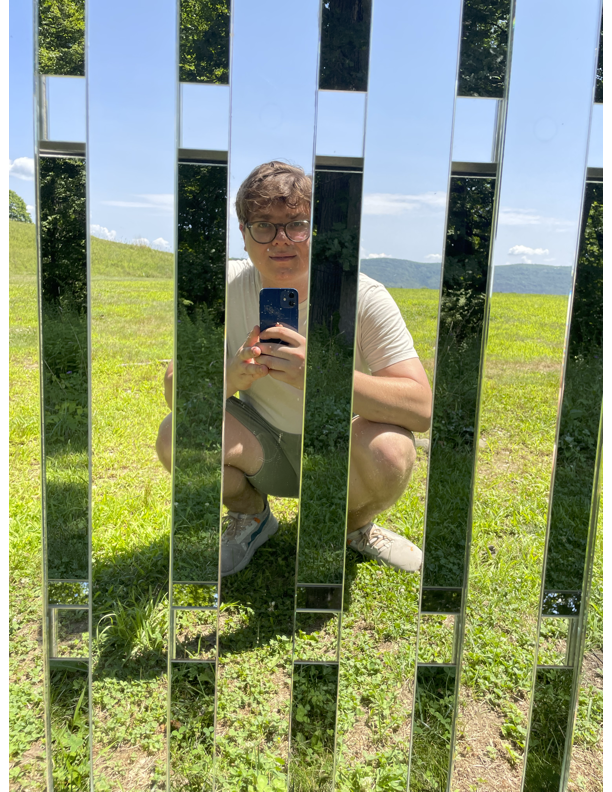
Hi! I’m a second-year physics PhD student at NYU with broad interests in the categorical structures which underlie quantum field theory (QFT). Before this, I was lucky enough to do my undergraduate studies at Penn State University under the mentorship of Adrian Ocneanu and do some research on tensor categories and Levin-Wen models under the supervision of Dave Penneys at Ohio State University.
In the last decade or so, the cultural zeitgeist surrounding QFTs has shifted to become increasingly more Yoneda-esque. By this I mean that physicists have become more conscious of the idea that rather than asking what “is” a QFT, we should instead study the “space” of all defects which can probe the theory.
While we are applying it on a higher level these days, this general approach toward physics is certainly not new. Even Ernest Rutherford knew in 1909 that the question of “what is an atom?” is somehow nonsensical: this question should be rephrased as “how do atoms (in a thin gold film) respond to all possible probes (charged alpha particles) that we can throw at it?”
Most of the questions I am interested in somehow pertain to how to appropriately formulate morphisms of QFTs and quantum lattice systems and what are the implications of this structure. Currently, I am trying to understand:
- Non-semisimple tensor category symmetries, their deformations, and their gauging in (1+1)-dimensional anyon chains and logarithmic CFTs.
- The generalized Landau paradigm and tensor network renormalization.
- Non-invertible symmetry enriched topological order.
If you are curious about my background, you can check out my CV, though it may or may not be a bit out of date depending on when you are reading this.
I love talking to anyone who shares even a passing interest in these ideas, so if you want to chat about anything, feel free to reach out via email at noah.ringrose@gmail.com!